
That gold chain in your drawer is worth more than you think, and probably less than you hope. Both can be true at once, and the gap between them is where most sellers get burned.
Nobody explains this part upfront: your gold’s value isn’t a mystery or a matter of opinion. It’s math. Three numbers decide almost everything, and once you know them, no offer can catch you off guard. This guide breaks down exactly how gold is valued, so you walk in knowing your number.
Here’s what we’ll cover:
- The 3 factors that set your gold’s base value
- Karat and purity, decoded from the tiny stamp on your piece
- Spot price and the melt-value formula, done step by step
- Why buyers offer below melt, and what’s fair versus a lowball
- How to sanity-check any offer before you say yes
At Gold & Jewelry Buyers, we walk you through the same math you’re about to learn, then hand you a free, no-pressure quote when you’re ready to sell your gold.
The 3 Factors That Set Your Gold’s Base Value
Strip away the mystery, and gold valuation runs on three inputs. Purity, weight, and spot price. That’s it. Every legitimate offer you’ll ever get is built from these three numbers, multiplied together.
Master them, and you stop guessing what your gold is worth. You start knowing. Let’s take them one at a time.
1. Purity (How Much Gold Is Actually There)
Your jewelry is almost never pure gold. Pure gold is soft, of the “bends in your fingers” variety, so it gets mixed with tougher metals like copper and silver to survive daily wear.
That mix is measured in karats, out of 24. The higher the karat, the more real gold you own, and the more your piece is worth per gram.
| Karat | Purity | What It Usually Means |
|---|---|---|
| 24K | 99.9% | Investment bars and coins |
| 22K | 91.6% | High-end and imported jewelry |
| 18K | 75.0% | Fine jewelry, designer pieces |
| 14K | 58.3% | The most common U.S. jewelry |
| 10K | 41.7% | Budget-friendly, U.S. legal minimum |
Flip your piece over and hunt for a tiny stamp. You’ll see either a karat mark (14K) or a three-digit fineness number (585 for 14K, 750 for 18K, 999 for 24K). That stamp is your first clue, though it’s worth verifying, and we’ll cover testing later.
Here’s why this matters more than sellers expect. A 14K piece contains barely more than half its weight in actual gold. So even a hefty chain won’t pay out as the scale suggests. The alloy metals holding it together? Worth close to nothing.
2. Weight (And the Troy Ounce Trap)
Weight is where a lot of sellers trip, and it’s a costly stumble.
Gold gets weighed in grams for smaller pieces, but spot price is quoted per troy ounce. And a troy ounce is not the ounce in your kitchen.
- 1 troy ounce = 31.1 grams
- 1 standard (kitchen) ounce = 28.35 grams
That’s roughly a 10% difference. Weigh your gold on a food scale, apply it to a troy-ounce price, and your mental math walks straight off a cliff. Precision pays here.
Pro tip: Small weight gaps swing real money. One jeweler recently logged a bracelet at 18.9 grams on a calibrated jewelry scale versus 19.2 grams on the customer’s home scale, a 0.3-gram gap that shifted the gold value by nearly $40 at that day’s price. Now scale that logic to a heavy chain.
3. Spot Price (The Number That Never Sits Still)
Spot price is the live, global market rate for one troy ounce of pure gold. It’s the baseline every buyer starts from, and it changes by the second during trading hours.
To put that volatility in plain terms: across a single week this year, gold traded anywhere from about $4,450 to $4,610 per troy ounce, depending on the day and source. Same gold, different Tuesday, different payout.
A few forces push that number around:
- Supply and demand across global markets
- Inflation and interest rates, since gold is a classic safe-haven asset
- Economic and political uncertainty, which tends to send buyers running toward gold
Spot price is a pure-gold, wholesale figure. It’s not what lands in your pocket. It’s the ceiling that purity and weight then shrink down to your piece’s real gold content. What a buyer pays sits below even that, for reasons we’ll talk about later.
Putting the 3 Together
Here’s the formula the whole industry runs on:
(Spot Price ÷ 31.1) × Weight in Grams × Purity % = Melt Value
Let’s run a quick example at a round $4,500/oz (an illustrative rate, not today’s live price):
- A 10-gram 14K chain
- ($4,500 ÷ 31.1) × 10 × 0.583
- = about $844 in melt value
That’s the gold content talking. Not the retail price, not the payout, just the raw metal math.
Want to skip the arithmetic? A live gold quote from our team runs these same three numbers against the current market and hands you a real figure, free and with zero obligation. Knowing the formula keeps you sharp. Getting it confirmed keeps you certain.
Karat and Purity, Stamp Decoded
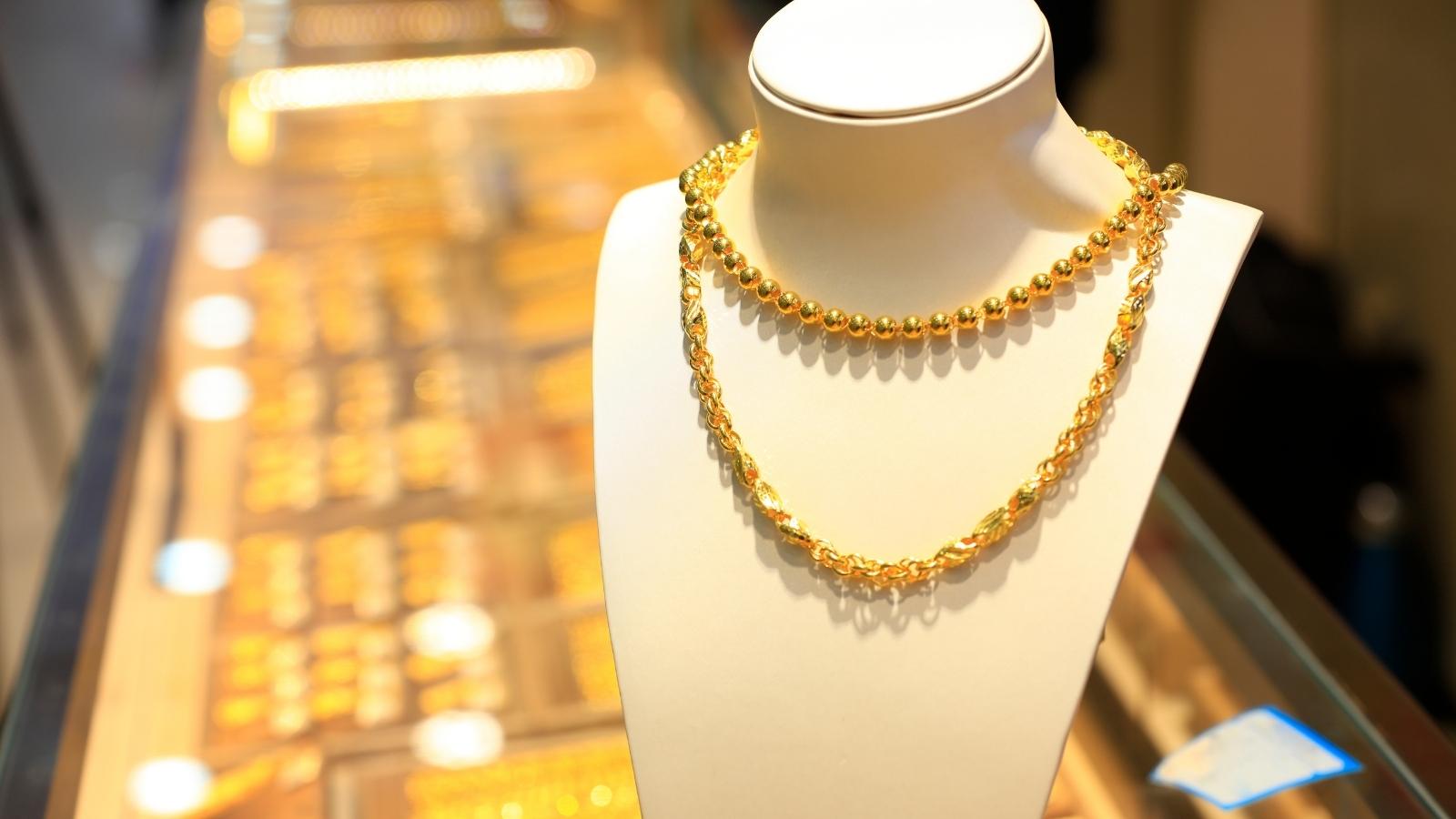
That tiny stamp on your clasp is the single most important marking on your jewelry. It tells any buyer, at a glance, how much of your piece is real gold versus filler metal.
Two stamping systems exist, and you’ll see one or the other:
- Karat marks: 10K, 14K, 18K, 22K, 24K
- Fineness numbers: 417, 585, 750, 916, 999 (parts of gold per 1,000)
They say the same thing in different languages. Here’s how they line up.
| Stamp | Fineness | Purity | Where You’ll See It |
|---|---|---|---|
| 10K | 417 | 41.7% | Affordable chains, class rings |
| 14K | 585 | 58.3% | Most U.S. gold jewelry |
| 18K | 750 | 75.0% | Designer and fine pieces |
| 22K | 916 | 91.6% | Imported and bridal gold |
| 24K | 999 | 99.9% | Investment gold, bars, coins |
Why the mixing in the first place? Gold has a relatively low melting point and is famously soft, so soft it would deform on your finger in pure form. Alloying it with copper or silver buys durability. That trade-off is exactly why your 14K ring holds its shape but carries barely over half its weight in actual gold.
Pro tip: A stamp is a claim, not a guarantee. Reputable buyers confirm purity with an acid test or, better, XRF analysis, which reads the exact metal content without a scratch. If a buyer offers you the same number for a 10K piece and an 18K piece of equal weight, walk away. Their melt values differ by roughly 80%, and someone’s getting shortchanged.
Only 10K and up can legally be sold as “gold” in the U.S. Anything below that minimum is a different conversation entirely. If your piece is unmarked, don’t assume the worst yet, since older and imported items sometimes skip the stamp. Get it tested.
Not sure what you’re holding? Our team reads stamps and tests purity daily, whether you’re looking to sell gold jewelry or a drawer of odd bits. No charge to find out.
Spot Price and Melt Value, Step by Step
Purity and weight tell you how much gold you own. Spot price tells you what that gold is worth on the open gold market right now.
Think of spot as the wholesale rate for one troy ounce of pure physical gold. It’s the same benchmark whether you’re in Fort Lauderdale, London, or Shanghai, because gold is priced globally in U.S. dollars. That’s why the current price you see on a live gold price chart is, functionally, the same gold price the whole world trades against.
Who Actually Sets the Price
Spot moves by the second, but there’s a formal daily anchor behind it. The London Bullion Market Association administers the LBMA Gold Price, set twice daily through electronic auctions at 10:30 AM and 3:00 PM London time.
Sixteen major banks submit bids until supply meets demand, and the clearing figure becomes a global reference for bullion prices, mining contracts, and central banks alike. It runs on the ICE Benchmark Administration platform, which took over from the old London Gold Fix in 2015.
The price of gold doesn’t move on a whim. A few forces do the heavy lifting:
- The U.S. dollar. Gold’s price is inversely correlated with the dollar, so a weaker dollar tends to lift gold prices while a strong one drags them down.
- The Federal Reserve. Rate decisions and monetary policy shift how attractive owning gold looks next to yield-bearing other assets.
- Economic uncertainty and geopolitical tensions. When financial markets wobble, gold demand climbs, since gold’s role as a safe haven and insurance policy kicks in.
- Supply. New mine production adds only about 2% to 3% to marketsupply each year, so the metal stays scarce by design.
The Melt Value Formula
Once you have your three numbers, the math is refreshingly simple.
(Spot Price ÷ 31.1) × Weight in grams × Purity % = Melt Value
Run it with a 10-gram 14K chain at an illustrative $4,500/oz:
- $4,500 ÷ 31.1 = $144.69 per gram of pure gold
- $144.69 × 10 grams = $1,446.90 (if it were 24K)
- $1,446.90 × 0.583 = about $843 in melt value
That last figure is the real value of the metal alone. Not retail, not sentimental, just the recoverable gold. Want the number run against today’s live rate instead of an example? A free gold quote does exactly that in minutes.
Critical point: Melt value is a calculation, not an offer. It’s the ceiling. Every buyer’s payout sits below it, and the next section explains precisely why.
Why Buyers Offer Below Melt
This is where trust breaks down, and where it doesn’t have to. When a buyer quotes below your melt-value math, the instinct is to assume a scam. Usually, it’s just the cost of doing business.
Nobody between you and a refinery works for free. That gap covers real expenses:
- Refining. Extracting pure gold from alloy takes equipment, chemicals, and expertise.
- Market risk. Gold prices can drop between the moment they pay you and the moment the metal is refined.
- Overhead. Rent, staff, insurance, testing, and shipping all cost money.
- Margin. A business has to earn something to keep the lights on.
That’s the honest version. The gap isn’t personal, and it isn’t automatically unfair.
What Different Buyers Actually Pay
Here’s the part that matters most: who you sell to moves your payout far more than what you’re selling. The same chain gets wildly different quotes depending on the buyer’s business model.
| Buyer Type | Typical Payout (% of melt) | Why |
|---|---|---|
| Pawn shops | ~40% to 70% | Gold is a sideline; offer covers unrelated overhead |
| Jewelry stores | Highly variable | Great for resellable pieces, poor for scrap |
| Coin/bullion dealers | Mixed on jewelry | Prefer recognizable gold coins and gold bars |
| Specialist gold buyers | ~80% to 95% | Refinery-adjacent, built for exactly this |
A pawn shop and a specialist buyer will look at the identical piece and quote numbers that aren’t remotely close. That’s not a coincidence. It’s the difference in how each business makes money.
Statistic worth remembering: Pawn shops often top out around 50% of melt, sometimes well below. A dedicated buyer working close to a refinery can pay in the 80% to 95% range. On a $1,000 melt value, that’s a $300 to $450 swing on the same gold.
There’s a flip side, too. Making charges and retail markup do not carry into resale. That $900 mall bracelet might hold only a few hundred dollars in gold by weight, because the original price paid for labor, branding, and store overhead you can’t recover. Fair valuation strips all that away and starts from bullion value.
This is exactly why we lead with transparent, competitive cash-for-gold offers and show you the math behind them. When you can see how the number was built, an offer stops feeling like a mystery and starts feeling like a fact.
How to Sanity-Check Any Offer
Knowledge is leverage. Once you can estimate your own melt value, no buyer can fog the glass. Run this quick gut-check before you say yes to anything.
Step 1: Know your melt value first.
Weigh your gold (ideally in grams, on a scale that isn’t your kitchen one), confirm the karat, and run the formula. That single number is your baseline for every offer.
Step 2: Check the offer as a percentage.
Divide the quote by your melt value. Under 60%? That’s pawn-shop territory. In the 80s or 90s? You’re dealing with a serious buyer. This one calculation exposes a lowball instantly.
Step 3: Get 2 to 3 quotes.
Never sell on the first number. Comparing offers is the single most effective way to protect yourself, and it costs nothing but an afternoon.
Step 4: Watch for red flags.
Trustworthy buyers make themselves easy to vet. Be cautious when you see:
- No physical address or verifiable business info
- Refusal to test your gold in front of you
- Pressure to decide right now
- A vague offer with no breakdown of weight, purity, and percentage
Ask the buyer to walk you through their math out loud. Weight, karat, spot price, payout percentage. An honest buyer will do this happily. A shady one will get cagey fast. Their willingness to explain is the test.
Step 5: Separate the specials.
Melt value ignores everything but metal. If your piece is a signed Cartier, an antique, or set with real diamonds, it may be worth far more intact than melted. Get those appraised separately before treating them as scrap. For pieces like that, our designer and estate jewelry evaluations look past melt to true resale value.
What Makes Gold Valuable at All
Before you sell a single gram, it helps to understand why anyone wants your gold in the first place. The answer runs deeper than shine.
Gold has been prized for thousands of years, and its value rests on physical traits that no other metal quite matches:
- Non-corrosive. It doesn’t rust, tarnish, or degrade, so a coin buried for centuries comes out unchanged.
- Malleable. Soft enough to shape into anything from a wedding band to a medicaldevice.
- Scarce. Rare enough to hold worth, common enough to circulate.
- A strong electrical conductor. Which is exactly why gold shows up in industrialuse, from smartphones to spacecraft.
Sit down with a periodic table, and few elements pull off that combination. That mix of beauty and utility is the root of gold’s perceived value, and it explains why the metal carries both symbolic value and hard, practical demand.
According to the World Gold Council, roughly 220,700 tonnes of gold have been mined in all of history, and because gold is nearly indestructible, almost all the gold ever pulled from the ground still exists today.
| Where the World’s Gold Sits | Approx. Share |
|---|---|
| Jewelry | ~45% |
| Bars, coins, and ETFs | ~22% |
| Central bank reserves | ~17% |
| Industrial, dental, medical, decorative | ~15% |
That table tells a quiet story. Gold jewelry isn’t a side category; it’s the single largest pool of above-ground gold on Earth. The piece in your drawer is part of the biggest slice of the pie.
Fact worth knowing: Industrial and dental applications, plus technology, still consume a meaningful chunk of yearly gold demand, thanks to gold’s conductivity and resistance to corrosion. Your old chain and a semiconductor chip lean on the exact same properties.
Whatever form yours takes, we buy gold in nearly all of them, from wearable jewelry to scrap, coins, and bars.
Gold as Money, Then and Now
Gold’s story as currency is what cemented its worth across long periods of history, and that legacy still shapes the price of gold today.
Standardized coinage kicked things off, with gold anchoring some of the world’s first coins. By the 19th century, the gold standard tied national currencies directly to the metal, giving paper money its backing and its purchasing power. Gold effectively was money.
A quick timeline of how that unwound:
- Into the early 1930s: Gold circulated as everyday currency in much of the world.
- 1944 to 1971: Under Bretton Woods, the US dollar was pegged to gold at $35 per ounce, and other currencies pegged to the dollar.
- 1971 onward: The U.S. cut that link. Gold floated free, and its price has answered to the open gold market ever since.
That history matters for one blunt reason: unlike most commodities, gold never fully shed its monetary role. It still behaves like a store of value, which is why central banks hold it to this day.
Why Big Players Still Buy Gold
Gold doesn’t pay interest. It generates no yield and no dividends, which sounds like a weakness until markets turn ugly.
- Central banks treat gold as a reserve asset, a hedge against a weaker dollar and shaky economic data. They hold a meaningful share of all above-ground gold, buying steadily to diversify away from any single currency. In 2025 alone, central banks added over 860 tonnes to their reserves.
- Gold investors and private investors reach for it during high inflation and uncertainty, since gold’s price performance tends to hold up when other markets wobble. Demand for investment gold climbed significantly in recent years, pushing prices to repeated records.
You’ve got options for owning gold, too, each with trade-offs:
| Way to Hold Gold | What It Means |
|---|---|
| Physical bullion | Real bars and coins you store yourself |
| Gold ETFs | Exposure to gold prices, no storage hassle |
| Gold certificates | A paper claim, no physical handling |
| Allocated accounts | Specific bars are legally yours |
| Unallocated accounts | A claim on a pool, not a specific bar |
Whether you buy gold bullion, trade bullion products, or simply hold heirloom gold jewelry, the same three fundamentals from earlier still set the floor under your piece’s worth. History gives gold its story. Purity, weight, and the current price give it a number.
When you’re ready to turn that number into cash, we make it simple to sell gold at a fair, market-based rate, no lecture required.
Know Your Gold’s Worth With G&J Buyers
Valuing gold isn’t guesswork; it’s arithmetic. Once you know your karat, your weight, and the day’s spot price, you can run the math yourself and read any offer with clear eyes. The mystery disappears, and the leverage shifts to you.
Here’s what to carry with you:
- Three numbers rule everything: purity, weight, and spot price
- Karat decodes the stamp; 14K is barely over half pure gold
- Melt value is a ceiling, never the actual offer
- Buyers pay a percentage, so 80% to 95% signals a serious one
- Always get 2 to 3 quotes before you say yes
That’s exactly where we come in. At Gold & Jewelry Buyers, we show you the same math you just learned, then back it with a fair, market-based offer. Bring your piece, watch us weigh and test it, and get your free quote. No pressure, no runaround.
Ready to put it to the test? Get a free, no-obligation evaluation from our team and see how your gold’s real number stacks up.
Frequently Asked Questions
What if I invested $1000 in gold 10 years ago?
Gold averaged around $1,250 an ounce in 2016 and trades near $4,500 today. That $1,000 in physical gold would be worth roughly $3,500 now.
What does $100,000 worth of gold look like?
Smaller than you’d think. At the gold price today, $100,000 is about 22 troy ounces, a stack of coins that fits in one hand. This precious metal packs dense value.
Does gold ever lose its value?
Prices dip in the short term, but historical data shows gold holds worth over time. Unlike paper assets, the value of gold has never hit zero across thousands of years.
Will gold go to $10,000 an ounce?
Nobody knows. Historical prices have climbed steeply and increased significantly in recent years, but no forecast is guaranteed. Watch the market before you sell gold.